
A knockout (KO) and a technical knockout (TKO) are both ways to win a fight in boxing and MMA, and people mix them up. The short version: a KO is a fighter who can't continue, usually because they're unconscious. A TKO is a fighter who is still conscious but can't defend themselves properly.
Boxing vs MMA rules
In boxing, if a fighter is knocked down, the referee starts a 10-second count. If the fighter can't stand and continue within the count, the fight is a KO. Loss of consciousness is an automatic KO.
MMA has no 10-second count. If a fighter is knocked out and can't continue, the fight is a KO immediately.
That changes strategy. A boxer may knock his opponent down and back off, knowing the count is coming. An MMA fighter can keep striking an opponent on the ground, because there's no count and the fight ends when the opponent can't continue.
What a KO is
A knockout is when a fighter becomes unconscious and can't continue. It's often the result of a powerful punch or kick to the head, which rattles the brain inside the skull. Other causes are repeated blows to the head, lack of oxygen from a choke, and injuries from falls or impacts with the ground.
What a TKO is
A TKO is when a fighter is declared unable to continue while still conscious, because they can't defend themselves properly. That can happen when a fighter is taking repeated strikes and can't defend intelligently, or when they can't safely continue for any reason. In boxing, a TKO can also be declared when a fighter can't defend themselves normally in the middle of a round, or because of injury.
Examples include the referee stopping the match because a fighter can't defend against a barrage of punches, or because of a cut that poses a risk to their safety.
Unlike a KO, which ends the match through loss of consciousness, a TKO allows for the possibility that the fighter could recover and keep competing. That's why the criteria for a TKO are strictly defined in the rules of boxing and MMA.
The referee's role

The referee's main job is to protect the fighters. They can stop the fight if one fighter is at risk of serious injury or can't defend themselves properly.
The referee can call a TKO if a fighter is taking too much punishment and can't defend adequately. They can also call a KO if a fighter is out and can't continue.
They have to know the rules and make quick, accurate calls. They can only judge what they can see, and they can't always prevent injuries.
Ground and pound

Ground and pound is striking an opponent with repeated blows while on the ground. It's a common MMA strategy. The goal is to do damage while the opponent is in a vulnerable position and can't defend effectively.
Fighters use punches, elbows and hammer fists on the head, body and limbs. It's effective because a fighter who can't defend themselves may be called a TKO by the referee.
Its effect on fighter safety is debated, and ground and pound remains controversial.
Boxing TKO vs MMA TKO
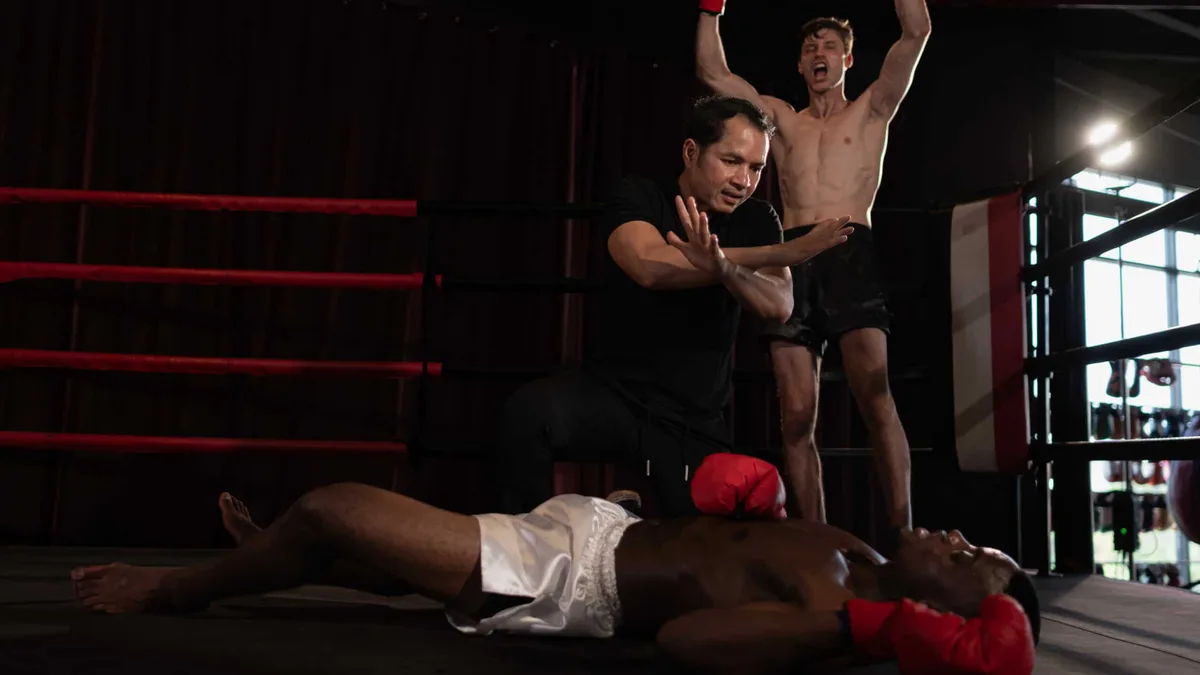
In boxing, a TKO is declared when a fighter can't defend himself properly, because of injury or exhaustion. If the referee decides he can no longer defend himself safely, the fight is stopped and a TKO is declared.
In MMA, a TKO is declared when a fighter is repeatedly hit and can't defend himself, or because of injury.
Because MMA allows ground and pound, a fighter who is knocked down is still in danger of a KO or TKO if he can't defend himself on the ground.
Injury and safety
MMA allows kicks, knees and elbows, which boxing doesn't. Referees and ringside physicians watch for signs of injury and stop the match if necessary.
| Measure | Boxing | MMA |
|---|---|---|
| Gloves | 8-16 oz | 4-6 oz |
| Rounds | 3-12 rounds | 3-5 rounds |
MMA's smaller gloves give less padding.
Frequently asked questions
What are some examples of famous knockouts in combat sports history?
Mike Tyson's knockout of Michael Spinks in 91 seconds, Anderson Silva's front kick knockout of Vitor Belfort, and Holly Holm's head kick knockout of Ronda Rousey.
How does a fighter recover from a knockout or technical knockout?
With immediate medical attention, rest and rehabilitation. The fighter's physical and mental state is evaluated, and they get time to recover before returning to training and competition.
Are there any instances where a knockout or technical knockout can be overturned or challenged?
Appeals are limited. Overturning a result is rare and only happens if there was a clear error in judgment.
How do judges score a fight that ends in a knockout or technical knockout?
Judges score it based on the events leading up to the stoppage, such as the fighter's performance, the severity of strikes and the fighter's ability to continue.
What are some common misconceptions about knockouts and technical knockouts in combat sports?
The main one is treating the two as the same thing. The specific rules differ between boxing and MMA, so check which sport you're talking about.