
The Peruvian necktie is a submission that wraps one arm around the opponent's neck and uses the other arm to secure their arm. It restricts breathing and loads the spine and neck, so it hurts and can force a quick tap. It's also a fan favourite because it looks so good.
What is the Peruvian necktie?
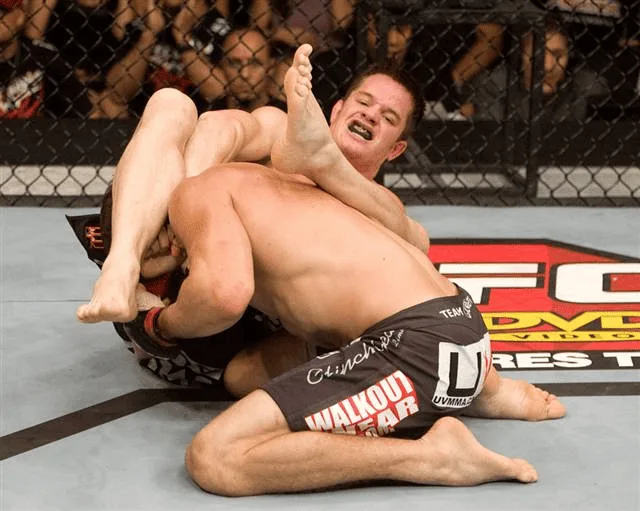
The Peruvian necktie chokes your opponent while trapping their arm.
First secure your opponent's head with one arm. Next, use your leg or knee to trap their arm. Finally, pull their head down while pushing the trapped arm up to choke them.
It can force a tap or put your opponent out, but it takes skill and precision and is hard to land on good opponents. In MMA it's often a surprise attack, and once it's properly set up it's hard to defend.
Technique breakdown
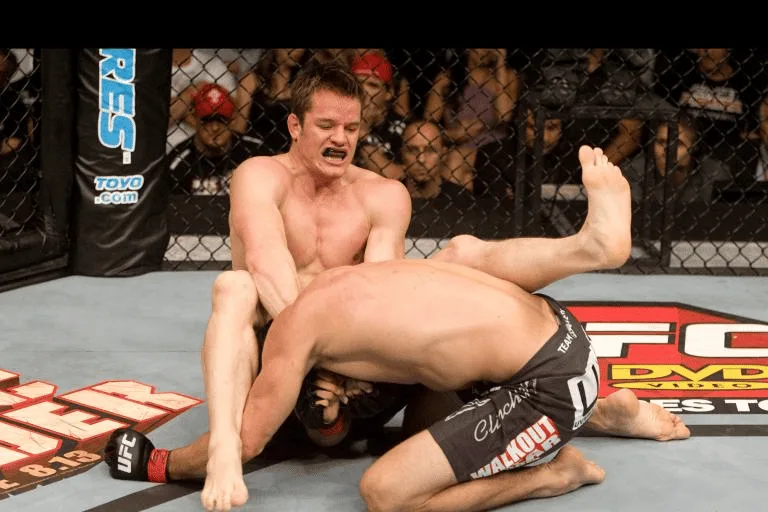
The choke is executed from the front headlock and can lead to a submission or a dominant position.
Setup
You need the front headlock, which you can get by sprawling after a takedown attempt or by transitioning from standing. Then secure your grip. The most common is the gable grip, with your hands interlocked and palms facing up.
Execution
Create pressure on the neck while cranking the head to the side. Use your arm to press on the neck while pulling their head toward your opposite shoulder, and use your other arm to secure their arm or leg so they can't escape.
Defending the Peruvian necktie
Tuck your chin to your chest so your opponent can't pressure your neck. You can also sprawl and create space. If they've already secured the gable grip, try to break it by pushing their hands apart.
Variations and transitions
The anaconda choke wraps the arm around the opponent's neck and presses on the throat. The D'arce choke also wraps the neck, but presses on the carotid artery. The necktie can also lead into other submissions, such as the armbar or the rear naked choke.
Common mistakes
Applying too much pressure too quickly lets your opponent escape or defend. So does a poorly secured grip.
Notable fighters who have used the Peruvian necktie in MMA
Tony DeSouza is credited with inventing it. Brad Pickett beat Kyle Dietz with it, and C. B. Dollaway beat Jesse Taylor with it at UFC Fight Night: Silva vs. Irvin in 2008.
Training and drilling the Peruvian necktie
Drilling
Start with the basic mechanics: getting into position, controlling your opponent and applying the choke. Once that's comfortable, work on the details and variations.
It helps to drill the necktie as part of a series, for example after a failed armbar attempt or as a follow-up to a successful takedown.
Building it into your game
The necktie isn't a standalone technique. Use it alongside other submissions and techniques. Consider your opponent's strengths too. If they're known for guard passing, you may want to use the necktie from the bottom.
Training tips
- Start slow: focus on the details to build a foundation and avoid injury.
- Train with a partner: it's partner-dependent, so work with someone willing to help you improve.
- Focus on the details: hand placement, body position and timing.
Common training mistakes
- Rushing the technique: it needs patience and timing.
- Neglecting defense: your opponent can still defend, and you can lose position or the submission.
- Over-reliance: it shouldn't be your only technique, or you become predictable.
Gi and no-gi
The necktie works in both gi and no-gi grappling. In the gi, you can use the lapel to control the head and create leverage for the choke. In no-gi, you rely more on body positioning and hand placement.
Training it for MMA
In MMA you need to apply it from several positions, including the clinch and against the cage, and be ready to transition to other submissions or strikes if it fails.