
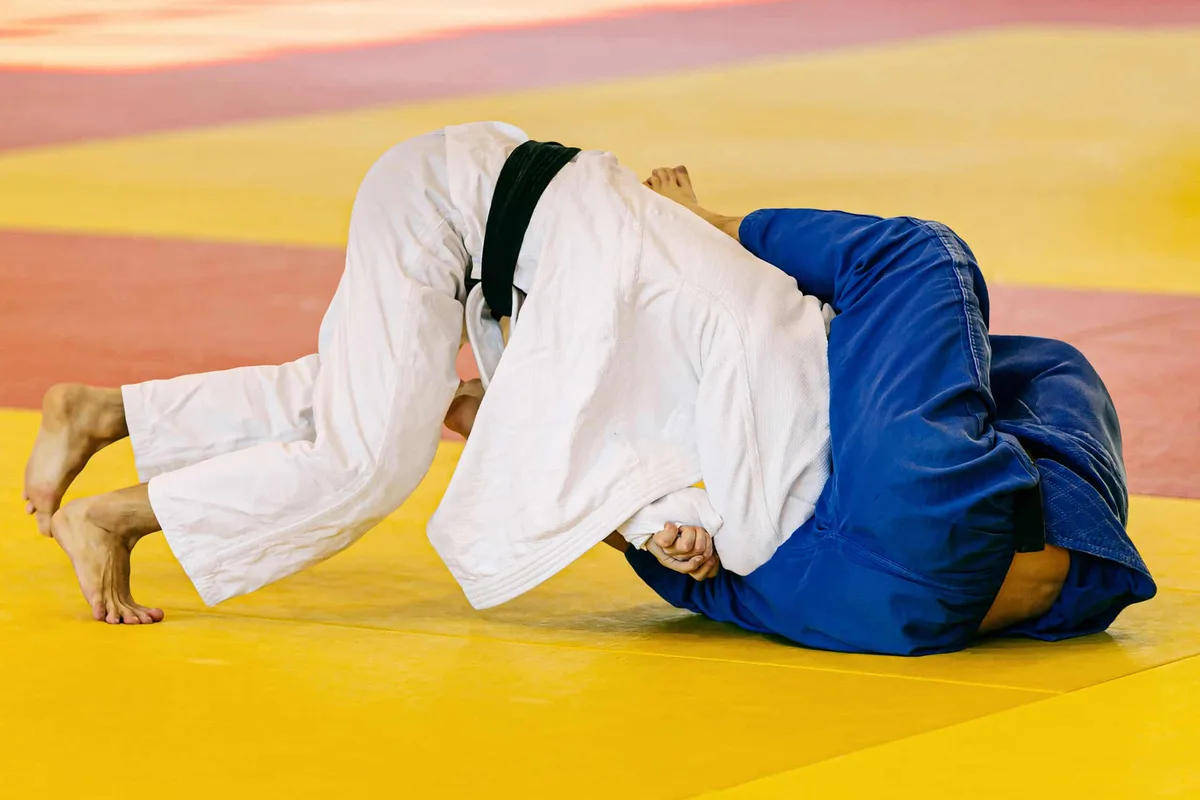
The triangle choke is a staple submission in mixed martial arts. You wrap your legs around an opponent's neck and one arm, and the pressure on the neck and carotid arteries makes them tap or lose consciousness.
Its strength is versatility. It can be set up from the guard, mount, and side control, and it can be used to finish or just to control. It also flows into other submissions such as the armbar or omoplata. It isn't easy, though. It takes technique, timing, and flexibility, so drill it regularly under a qualified instructor.
What is a triangle choke?
A triangle choke is a submission used in MMA and Brazilian jiu-jitsu (BJJ), applied from positions including the guard, mount, and side control.
The mechanics of a triangle choke
The fighter wraps their legs around the opponent's neck and arm, forming a triangle. They then squeeze their legs together and pull down on the opponent's head or arm.
The choke cuts off blood flow to the brain, and the opponent loses consciousness if it isn't released in time. Applied with enough force, it can also damage the neck and spine.
Why is it effective in MMA?
First, it can be applied from several positions, so it's usable in many situations.
Second, it's a high-percentage submission. Once locked, it's hard to escape, and it can come quickly and with little warning.
How to perform a triangle choke
The triangle is applied from guard. You trap your opponent's head and one arm with your legs to form a triangle, then apply pressure to the neck to cut off their blood supply. The basic steps:
Setting up the position
Start in guard and control your opponent's posture by keeping their head down and their arms close to their body. Hold their head with one hand and an arm with the other.
Next, create the opening by lifting your hips and bringing one leg up and over your opponent's shoulder. That leg goes behind their head, while your other leg stays wrapped around their waist.
Executing the submission
With your opponent in the triangle position, lock the choke. Bring your free leg across their neck and put your foot on their hip. Grab your shin with both hands and pull down on their head to create pressure on the neck.
To finish, adjust your position and squeeze your legs together to cut off their blood supply, and keep pulling down on the head. They should tap.
Countering the triangle choke
Preventing the setup
The best counter is to stop it being set up at all:
- Maintain posture: A common setup is to break your posture and control your head, so keep good posture and keep your head up.
- Stay active: A passive opponent is easier to set up on. Keep moving to make it harder for them to control you.
- Watch for the setup: If they start controlling your head or legs, act to defend.
Escaping the submission
If the choke is already locked, there are still ways out:
- Posture up: This is the first move. It relieves pressure on your neck and makes the finish harder.
- Create space: Push their knee down and away from your head to make room between your neck and their leg.
- Rotate your body: Turn towards the trapped arm to relieve pressure on your neck and make it harder for your opponent to finish.
Famous examples in MMA
Notable fighters who have used the triangle choke
- Demian Maia: his Brazilian jiu-jitsu is exceptional, and the triangle choke is one of his signature moves. He used it to finish several UFC opponents.
- Tony Ferguson: another grappler who has used it to great effect. He submitted Kevin Lee with a triangle choke in the third round at UFC 216.
- Nate Diaz: a skilled Brazilian jiu-jitsu practitioner who finished Kurt Pellegrino with it at UFC Fight Night in 2008.
Memorable moments
- Royce Gracie vs. Dan Severn: at UFC 4 in 1994, Gracie won the tournament final with a triangle choke. Severn was much larger and stronger, and Gracie beat him with technique.
- Anderson Silva vs. Chael Sonnen: at UFC 117 in 2010, Silva caught a triangle armbar in the fifth round to retain his middleweight title, after Sonnen had dominated much of the fight.